In a live performance scenario, having knowledge of cable routing is a necessity. The cable connections of a stage setup could be likened to the human nervous system, an assemblage of wires all interconnected to provide a pathway to a stable body and if a connection happens to be wrong, there can be severe consequences. The signal begins on stage at sound source (instruments) with the end goal being the speakers. Of course, during this journey there are multiple processes it must undergo.
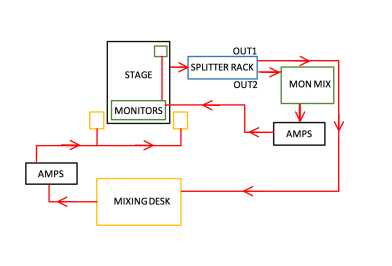
The sound must first be converted to electrical signal, most commonly with the use of microphones, otherwise by direct injection. From here the sound will be processed via a mixing desk. However, in professional productions, sound is usually split between two mixing desks – One front of house and one side-stage for monitoring. This is done via a splitter-box rack. In scenarios where only a single desk is employed instruments would go directly in to a multicore and in to the desk, to be managed by auxiliary outputs, which feed in to separate amps. From the splitter rack, the signal run to the each mixing desks channel inputs. The signal can then be processed here to adjust dynamics, EQ and inserted or auxiliary effects. The main output of the front of house desk is fed to amplifiers and then to the speakers, usually via speakon cables. The main outputs of the monitor desk (which usually contain more outputs) are fed to amps and then to monitor speakers (wedges). The result is a separately managed mix, which allows more focus to be applied to each aspect of the production.
 Jordan Vaughan: Creative Sound Design