WBL: Tricks for mixing wide guitar

In most conventional guitar band music you may notice that the guitars are wide and huge and cover most of the stereo field. This is because in most traditional senses the guitar is the musical driving force of the song from mid to high range and therefore requires a lot of attention from the listener. To achieve prominent guitar I have found a few techniques that work really well.

Double tracking.

First and foremost in this list we have double tracking. Recording a double track of a guitar does exactly what it sound like it would, it puts two guitars in the mix. The interest hear comes when we pan the guitars to opposite sides of the stereo field. If the guitars are playing the same lines in time with one another when we pan the guitars either way we exploit the phantom stereo field by giving our ears twos sounds that are indistinguishable, but still very slightly different and this creates an image that our brain can only decode as one huge, wide sound source. Double tracking a guitar however does remove some presence of the sound because the regardless of how good the guitarist is their will always be slight differences in the recording of a sound and double tracking this removes our ability to define the sound source precisely. This should be taken in to account in the approach of to your track.

Double tracking for soft excitement

When a guitar calls for a less in your face approach, this technique can add a beautiful glisten to the sounds of your guitar. This technique works well for picked guitar acoustic or electric, but usually cleaner sounds. The same process is undergone as before, the tracks have double takes and are panned across the stereo image, but then we zoom right in and drag one of the guitars very slightly out of time with the other. I’m talking milliseconds here, just enough so that the sounds attack at different times but not enough so that we can hear the difference as a slapback. This stacks the phase properties of each guitar against each other and creates a shimmery, chorus like effect.

Pan The Reverb

For ultra-wide guitars we can pan the reverb track to the other side of the mix, creating the idea of a huge space. When this is used in conjunction with a natural mix, we perceive the guitar as larger than life. To achieve this bus the signal into an aux, stick a reverb on the channel and then start panning, listening out for those desirable artefacts. I find around 50 percent on the opposite direction of the original signal works well.


WBL: EQ methods for bass definition

So, recently I’ve been working with a band that have a sort of psychedelic trip-hop, massive attack sort of vibe. If you’ve ever listened to anything by massive attack or similar artists you’ll know that the tracks sound phenomenal and an aspect that really stands out is the definition of the low end that they somehow achieve. If you listen to anything off the Blue lines album you’ll know exactly what I’m talking about. Creating this low end response is something I have been tinkering around with for a little while now and here are some little tricks I’ve found that work fairly well.


Multitrack EQ method

So, this method of mixing bass involves having multiple bass channels. One with a mic, one DI’d! The DI channel provides the clean low end that that can be boosted and processed easily. The mic track is then low cut. Mix these two together with appropriate plugin choices and it provides a big clean bass sound capable of driving the groove.


Pultec Low-end trick

This technique is reliant on a Pultec EQ. Like many sonic phenomenon within music mixing, this method exploits the physical design of a piece of hardware. This technique also works on emulations of this hardware because of the way that it functions. The Pultec EQ allows frequencies to be boosted and attenuated at the same time. So to get a rich low end we sweep through looking for a nice sounding frequency range between 70 and 180 and we boost and attenuate the same frequency, by the sam amount. The nature of the Pultec EQ finds the frequencies slightly out of line with one another creating a unique sonically interesting EQ curve. Which creates a full, warm and rich low end signal to be mixed in to the track.


WBL: a little bit of producing

In the modern music industry, the key to success seems to be the ability to function in multiple different disciplines. With music being such an accessible platform in the modern world, to set ones self apart from the crowd, we need to be able to apply ourselves well in multiple areas and provide multiple services. This is down to the job demand in the music industry being much lower than the amount of workers it provides for.

over the past few months, I have been trying to apply my own knowledge of composition and production to other artists. This has consisted of multiple sessions writing, producing and engineering.

This process has provided some huge challenges. Over the course of this project I have had the pleasure of working with several artists. The steepest learning curve for me came in the form of a female singer songwriter. Producing and engineering for her was a huge challenge for me and still is. This particular project has allowed me to work within restrictions that I usually would not have, such as minimal instrumentation and very accurate vocal presentation. Producing and writing with a solo artist who plays guitar has forced me to review my approaches to songwriting and producing relying more heavily on well written music and less so on the, in the box magic that so often is relied on to create music. Modern pop music is very reliant on production style and post processing to achieve a cohesive nice sounding track, by removing this I was forced to analyse the components of songs without the computer music mindset, which has actually led to me develop a wider understanding of acoustic instruments and allowed me to be able to help write much more cohesive instrument parts. So all in all a very useful process.


WBL: mixing variety for technical improvement

During my time at Western Audio Sam gave me a little advice in a passing comment that stuck with me “Listen to everything, mix everything”. I inferred this to mean the wider the range of things I mixed, the better I would get. So over the past few months I have been mixing in genres that I wouldn’t have explored for enjoyment, or come across in projects. Of course this process has demanded that I also listen to a wider variety of music. Which at times has been slightly unbearable, but overall an enlightening experience. Being able to apply my skills across new platforms has been interesting! It has definitely been effective in teaching subtlety. For example, I’ve never needed to mix a sonically beautiful acoustic guitar, because I usually mix more traditional guitar band music. So finding new ways to explore the sonic makeup of even such a mundane instrument, but for a different application was incredibly insightful as a process.


Without doubt the hardest challenge for me through this task was attempting to mix metal. I believe I found this so hard because I found the listening and analysis process really hard. To achieve the best mix I could I have been trying to absorb as much reference music as possible. Now I am a huge fan of  some metal, I love crunchy distorted guitars and hard drums and voices pushed to the point of breaking. What I can’t seem to enjoy is fast metal with 64th note arpeggios and constant double kick drum patterns. So, I think I found mixing this so hard because I just can’t conceptualise a nice sounding mix. Perhaps I should work on applying  subjectivity to my work. But hey, you were all idealistic once and I’m sure one day I’ll have to. But perhaps there is reason that mixing metal is a niche field of work.

WBL: TYPES OF EQ

Equalisation is used widely throughout the music industry. They are most commonly used to alter or manipulate the frequency response of a sound recording in order to improve it’s comfortability in the mix. They can also be used to flatten sound systems in order to optimise the volume levels. EQs are one of the most important tools in a mix engineers arsenal and to be as good as I can possibly be at mixing I should become acquainted with the type of EQ and the best way of using each. There are four main types of EQ; Shelving EQs Graphic EQ, Parametric EQ and semi-parametric EQ. Below are the described functionalities of each.


Shelving EQs

This type of eq is the most simple and inexpensive, can be found in any common equipment such as a stereo or Hi-Fi equipment. It offers the possibility to control the bass and treble, sometimes it also has a mid control. You can increase or decrease the gain and the central frequency and bandwidth are fixed, this type of equaliser is less commonly used in professional audio but can be a simple way to control EQ. This type of EQ in my experienced is most commonly observed on guitar amplifiers. Shelving EQ’s are extreme and therefore not suited to subtle use.

Graphic EQs

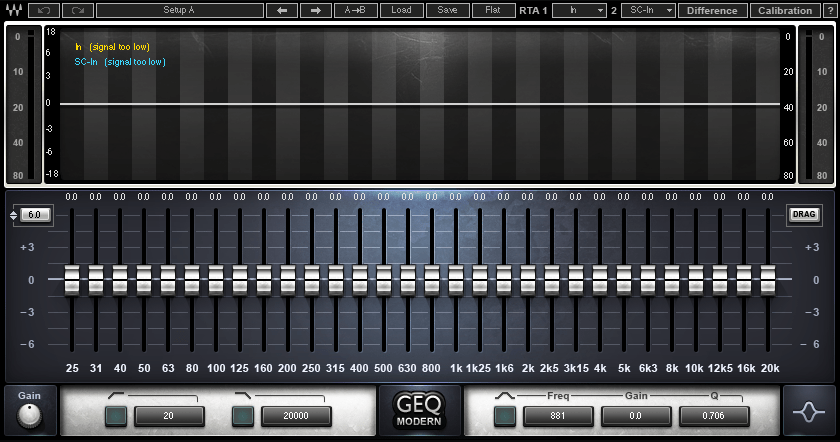
Graphic EQ’s consist of banded frequencies each with an individual gain control allowing the engineer precise control. However the flexibility of these modules can be problematic as the targeted frequencies are set in stone. They’re different types of graphic equalizers, the most common is the octave graphic equalizer, which has 10 frequency controls. This is pretty consistent because the audible bandwidth runs 10 octaves that are 30 Hz, 60 Hz, 125 Hz, 250 Hz, 500 Hz, 1 KHz, 2 KHz, 4 KHz, 8 KHz, 16 KHz. And it is in those frequencies where we can increase or decrease the intensity of the audio signal. The H-EQ by waves offers a much wider range of frequencies: Known as 32 band EQ.

Screen Shot 2018-04-26 at 16.27.59.png

Parametric EQs

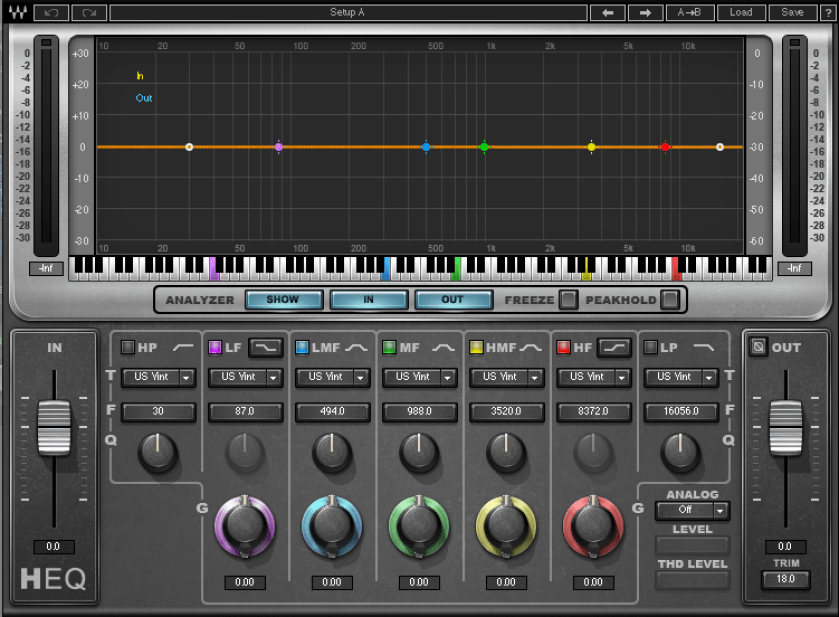
Parametric EQs are the most precise and versatile of the range of equalisers available to us. These EQ’s can contain many filters each with fully adjustable parameters of frequency, gain and bandwidth making it the most dexterous and precise type of EQ we can use. Parametric EQs are the most common type of EQ in the music industry and are very good at making corrective changes as well and creative.

Screen Shot 2018-04-26 at 16.33.37.png

Semi-Parametric EQs

This equalizer is similar to the parametric EQ in the sense that it allows you to select the frequency you want to equalie and the gain.However, it differs from the parametric EQ because you can not change the allocated bandwidth. This type of EQ is commonly seen on mixing desk.

To be an adept mix engineer, I will have to familiarise myself with all of the circumstances for which to use each EQ and develop my own work flows with each. It is also worth mention to say that some hardware equaliser’s circuitry colour the sound. This is known as an EQ not being transparent and dependent upon its application this can be a benefit or a detriment.


Information sourced from: https://www.masteringbox.com/types-of-eq/

WBL: The importance of mono mixing

One of the largest problems facing a mix engineer is the unpredictability of the receivers  listening platform. In this modern technological age music is consumed constantly but the variety of listening platforms available make it impossible to determine the platform that the track is being mixed for. It must therefore be optimised for all listening platforms. The two most common spacial imaging setups within music are stereo and mono. Stereo referring to the use of two speakers to create a stereo image and mono referring to a single speaker with spacial, directional abilities. Common stereo platforms are headphones, car speakers, or computer speakers. Common methods of listening in mono are laptop speakers, wireless bluetooth speakers, Amazon Alexa’s and phones. With us being unable to predict where our mixes will be listened to it is of the upmost importance to check that mixes work in both mono and stereo.

To achieve this we should aim for a mix that contains the same information whether in mono or stereo but stereo simply providing a wider stereo image. To do this we firstly remove the concept of stereo imaging and focus on the dynamic and frequency relationships between the sounds, EQing and mixing our tracks so that all of the instruments are clear and cohesive. This process must take place because our brains are very good at differentiating sounds if they are placed within a space. Meaning that we are much more capable of isolating a sound source mentally if we receive it in different ears. This is often referred to as the cocktail party effect. If we have many sound sources being received by the same ear at the same time we are incapable of decoding the sounds. Effectively meaning that introduces the stereo image too early in the mixing process can lead to not noticing crucial problems because we are able to decode the sounds because our ears are receiving them respective of our positioning. So by adding mono flip we are able to work on the sonic and dynamic qualities of the sounds against one another truly.

Many plugins offer the capabilities of mono flipping, my particular go to plgins are the Scheps 73 because I like the sound that it makes anyway and it is capable of a high level of transparency so its suitable for use on a master bus and the Waves SSLChannel for similar reasons. If using a software plugin for mono/stereo flipping it is a good idea to setup a keyboard shortcut for quick checks, making the process more intuitive.

WBL: The four main types of compression

A compressor is a specialised amplifier used to reduce the dynamic range of audio (the range between the highest and lowest transients). Compression, broadly, is the act of reducing the dynamic range of signal. The entire signal can then me amplified during the makeup stage. Different types of circuitry are employed with differing results. Each of these results apply unique sonic characteristics suitable for individual applications.

To increase my abilities within the world of mixing it is important for me to fully understand the circumstances in which each type of compressor would be useful. Of course, this will develop in the applied use of different types of compression.


1. Tube Compression

Tube compression uses vacuum tubes to amplify a signal. The nature of the vacuum tube when driven results in a compression action with unique characteristics. Tube compressor’s tend to have a lower input response  resulting in slow attack and release settings. This adds harmonic distortion to the sound which is often a desired qualities in mix engineers, in applications such as gluing. This process is nearly impossible to emulate across other types of compression.

2. Optical Compression

Optical compression uses a light emitting component in combination with an optical cell to attenuate the output signal. The higher the input signal, the brighter the light shines causing the attenuating circuitry to work harder. A famous example of this type of compressor is the LA-2A. The LA-2A also uses a tube element in the makeup gain process.


3. FET Compression

FET compression applies ‘Field Effect transistors’ in linear bistable operation, in place of Vacuum tubes, because they are cheaper to manufacture. These transistors by nature also react a lot quicker than vacuum tubes and therefore provide a more punchy compression sound. This makes FET compressors good for applications such as parallel drum compression. An example of a FET compressor is the 1176.

4. VCA Compression

VCA or ‘Voltage Controlled Amplifiers’ compressor employ solid state or integrated circuits to compress a signal. VCA compressors tend to be cheaper than the other varieties or compressor. They also provide much less colouration. An established example of this compressor is the DBX160.


WBL: The importance of the listening environment for mixing

The right listening environment is the most key tool an engineer has in their arsenal. To provide a flawless mix it is required that the engineer is able to concisely define flaws and this requires a suitable environment. If the listening environment is viewed as the canvas and the engineer a painter, it would be almost impossible to create a piece of canvas was in the dark. We don’t perceive these issues as relatives, because we as consumers and human beings are are frequently provided with examples of pristine image quality and therefore know if something is sub par. This however is not the case for music consumption as we are almost never provided with a perfect listening environment and cannot therefore reference it. This is down to the differential physics of sound and light and the way in which they react to our environment. However, the necessity of clear monitoring is essential for both creative processes.

When talking about monitoring environments, we are often told that the aim is a flat room. This isn’t strictly true but it is definitely in the right ball park. When treating a room the aim is to provide the most true representation of sound and as almost no space is naturally flat in frequency response, it seems a little counterintuitive to mix within one. A good listening environment should provide a clean frequency response with minor colouration. As long as each section of the frequency spectrum is audibly clear we are heading in the right direction.

Most professional grade studios adhere to what is known as the “analogue curve”. This phenomena describes the a gradual roll off of frequencies from the upper midrange onwards. This is helpful for a few reasons. The curve initially occurred as a compensation method for the loss of high end frequency content on magnetic tape allowing engineers to record a brighter sound to the tape initially. But has been adapted over recent years to help reduce high frequency ear fatigue, helping to avoid mixes becoming too bright. When ear fatigue sets in, we lose our perception of high frequencies, analogous of a frequency roll off pad, meaning that we over compensate and increase the high frequencies more than is desirable.

This having been said many digital recording rooms are able to bypass this curve because there is no loss of audio in the digital domain. Bob Hodas states ” However, the fatigue factor is still at work, and if any roll-off is applied, it is usually based on the engineers listening levels. I believe that one of the reasons many of the early digital recordings were harsh is that they were made in rooms originally set up to do analog work. Old habits die hard in the audio trade.”


Achieving a good listening environment requires the application of a combination of techniques. Firstly, one should address room layout. Everything within a room from the walls to the empty coke can on the desk affect the way a room sounds. So to treat a room every detail should be addressed. In a budget-less world, the room could be floated to reduce audio bleed and your monitor’s should be floated by a multi-thousand pound hanging system. But in the world that I live in these just aren’t possible. To address the issue of the listening environment I have implemented the following techniques. When building the room I parallel mirror offset the walls by 3 degrees in each parallel set of walls to avoid standing waves. I used triple layered dB plasterboard and double thickness Rockwool, with a 20mm air gap to  achieve the highest absorption coefficient  possible for the space and budget. I then measured the rooms frequency response and RT60 values. After studying these results I began building diffusers. Unfortunately because of the size of the space their is not enough room in my mixing room for bass traps – I decided that having a seating space for clients was more pertinent as a lot of the work I currently do is producer based and requires long sessions with artists to develop. Distinguishing where the sound first meets the wall I implemented diffusers to break up this sound and avoid reflection and medium transference.

To improve my listening space I could look in to methods such as Sonarworks reference 4, which uses a computer application to measure the room and tailors the output of the system to act flat within the room. I could also experiment with different types of treatment to see which provides the best results.

WBL: Isolating near-field monitors according to budget

Near field monitor speakers are used in the process of mixing and producing music to provide a clear, accurate representation of the sound. This is important so that the engineer is able to determine whether or not a change needs to be made. In essence a flat response means we can hear a true representation of a sound. A room is made flat in a number of acoustic solutions. The sound of a room will be heavily affected by the dimensions of a room and material makeup of the room itself. To treat this we use items such as diffusers, bass-traps and absorbers. When we refer to isolating speakers this means to isolate them from sound conductive materials. Your room may sound amazing but if the speakers are resonating with the desk, the sound you hear will be muddy and inaccurate. When a speaker resonates with a different object it creates a new sound source, a source that will not be present in other listening environments and therefore is an inaccurate representation of the sound, not to mention it will sound nasty.

For more in depth information on overall room treatment visit:http://www.bobhodas.com/optimizing-the-studio-listening-environment.php

When treating speakers specifically, the idea is to dissect the conduction of sound waves by placing a non conductive material between the sound source and the desk/stand. These materials can either be really expensive or dirt cheap and of course in this range, we can expect differing results of effectiveness.

Starting from a the high end of the spectrum we have products such as the Iso Acoustics GAIA puck which retail at around £80 per item. And with at least 6 of these being needed, this is definitely not a budget solution. These work by introducing a suspension based air gap set between two ceramic plates (ceramic is really good at absorbing sound), to diffuse all of the sound before it has a chance to achieve medium transference.

Getting a little cheaper we have isolating stands such as the Iso Acoustics L8R200, which retail at around £120 a pair and work by adding a conductive stand between the speaker and the desk.

Getting cheaper and more ineffective we have the old insulation foam. Foam is an okay conductor of sound. The problem here is single medium transference. With the speaker resting directly on top of the foam, it has no chance of escape and all of the heavy lifting is expected from the acoustic foam, which it just isn’t capable of. Using foam as a room diffuser is more effective because the sound is not concentrated when it meets the new medium (it has been allowed to diffuse in the air), but when speakers are resting directly on top of foam this is eradicated and the sound is much more prevalent and hard to deal with.

Getting absurdly cheap we have the old half a tennis ball trick. Whilst this is preferable to no treatment at all, it has a minimalistic effect. However this having been said, when the room sound is measured with software such as Room EQ wizard there are significant difference is the frequency response, especially in the bottom end. I believe this is because the tennis balls at least eradicates direct medium transference.

Next we have layered carpet tiles, which have a similar effect to the tennis ball. Definitely better than nothing at all. But not great!


With research I have discovered there are many DIY solutions to this problem and I would be interested to see how effective these actually are. Perhaps a project for the future.


Shepard Tones: Dunkirk

The Shepard tone, named after Dr.Roger Shepard, a cognitive scientist that worked for Harvard university and Bell Laboratories, is an audio illusion that exploits the human brains inability to follow multiple pitch and dynamic changes at the same time. This illusion consists of three rising scales, each an octave apart, with the highest falling in volume, the lowest rising and the middle staying at the same. As stated before, when these scales are rising and automating in volume we are unable to track the progress of each and we perceive this as a constant rising tone.

This is effective in a musical score because it is an endless supply of tension. When we hear scales rising chromatically, the intervals between the notes are not harmonious, if the instrument has release and this combined with the Shepard tone help to force viewers to the edge of their seats.


Here is an example of Shepard tones at work in the film Dunkirk, composed by Hans Zimmer.


I used a synthesiser, with a noise oscillator mixed in, to create this effect within my Philips Carousel project. I introduced the noise oscillator to introduce more paranormal connotations.  I played a chromatic scale started at the route note of the project (E) spanning over an octave, duplicated this over three track.  I found that if i applied the Shepard tone module with the velocity it left me free to mix the overall dynamics of the tone. Alongside volume automation, the Shepard tone proved to be fairly effective.

Design a site like this with WordPress.com
Get started